Brooch OEM Cost Breakdown for United States Manufacturing RFQs
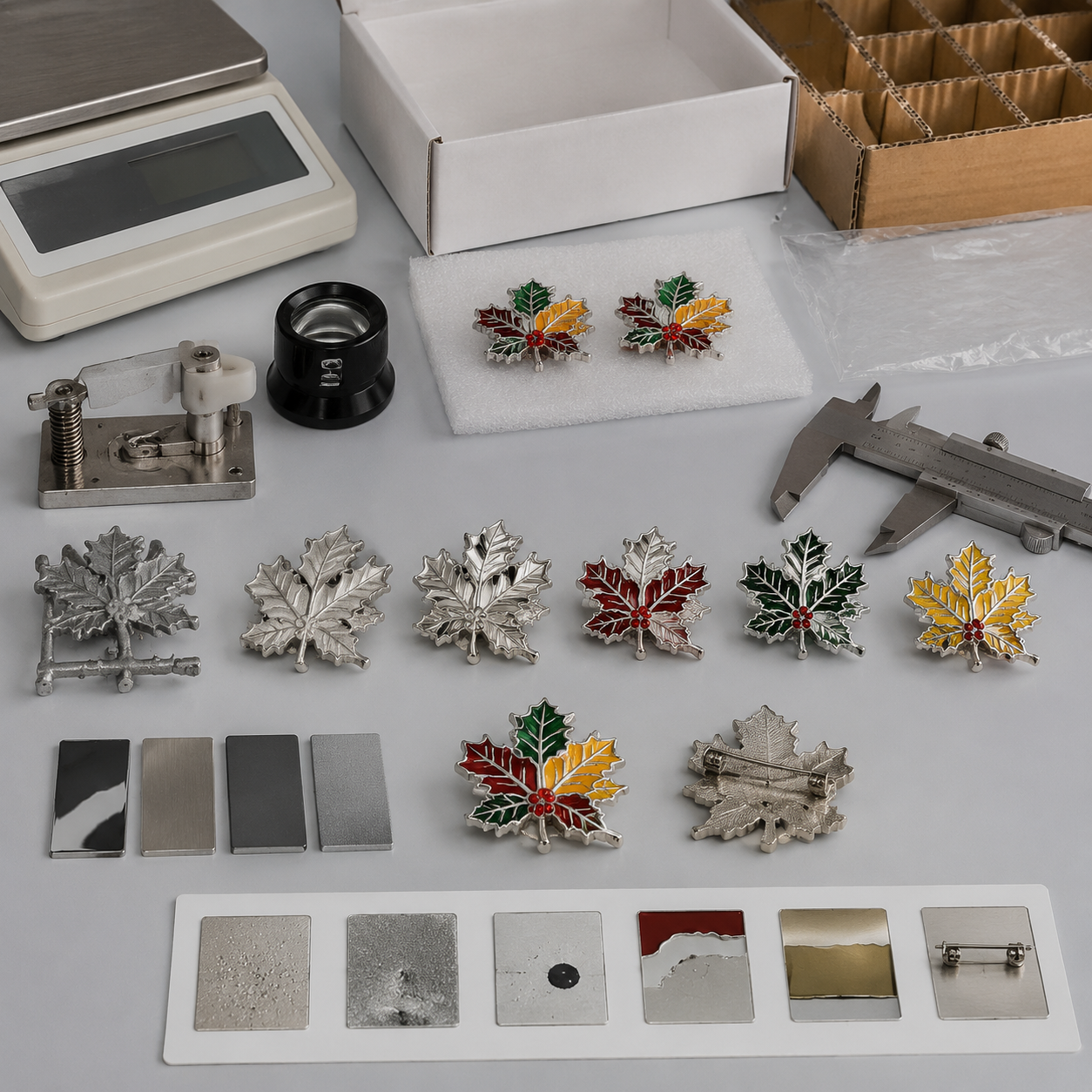
By Vincent Xi, Editorial Author
For United States business-to-business buyers, a brooch OEM cost breakdown is useful only when every bidder prices the same controlled product revision and delivery scope. The RFQ should identify the drawing, bill of materials, artwork, base material, decorative finish, pin hardware, pack format, label instructions, inspection evidence, named United States receiving point, and remedy for shortage or nonconformance. Compare buyer-paid cost per accepted unit rather than an isolated supplier handoff price.
The Wise supplier cost breakdown analysis provides a general category frame covering material, labor, overhead, logistics, and margin. It does not provide a brooch price, verify a manufacturer, or determine United States classification or duty. The sections below apply that category frame to a brooch manufacturing RFQ and separate editorial buyer controls from questions that require current transaction or regulatory evidence.
Scope: This is a manufacturing cost-and-RFQ page for United States purchasing. It is not a generic country guide. Treat an unanswered cost, specification, labeling, inspection, or delivery field as Pending; do not silently treat it as included or zero cost.
Brooch OEM Cost Breakdown: Comparable Manufacturing Inputs
The following matrix is an editorial RFQ control built from the category frame above. It does not describe a particular supplier's operating practice or product capability.
| Cost layer | Ask the bidder to price or disclose | Comparison control |
|---|---|---|
| Recurring brooch manufacturing | Base material, forming route, deburring, surface preparation, decorative fill, plating or coating, pin hardware, assembly, and routine production checks | Unit basis by SKU and quantity break; list included operations and substitutions |
| Recurring packaging and labeling | Protective material, backing card, insert, unit box, divider, carton allocation, artwork setup, and marking application | Pack drawing and packed data; separate artwork or setup from per-unit application |
| Nonrecurring product work | Tooling, fixtures, artwork conversion, setup, and pre-production samples | Separate charge plus ownership, reuse, storage, maintenance, modification, replacement, and payment trigger |
| Lot and shipment work | Buyer-required inspection or testing, export document handling, and shipment preparation | Charge per lot or shipment; identify repeat trigger, scope, and payer |
| Import and United States delivery | Trade term and named place, freight, insurance, brokerage, duty or additional-tariff placeholders, and domestic delivery | Separate included, excluded, buyer-supplied, and pending amounts; retain dated evidence |
| Failure exposure | Sorting, reinspection, rework, replacement, credit, shortage, and delay remedy | Contract states the responsible party, trigger, evidence, and cost treatment |
Use the statuses Included, Excluded, Buyer supplied, and Pending in the comparison sheet. Keep recurring product and packaging separate from one-time charges and shipment charges. An offer may group overhead or margin, but it should still identify inclusions, exclusions, and changes in material, currency, quantity, specification, or timing that permit repricing.
Use one accepted-unit formula after all deviations are resolved:
accepted-unit cost = (recurring product + packaging + allocated nonrecurring + lot or shipment + import or delivery + buyer-paid failure costs - contractual credits) / accepted units
Keep ordered quantity, received quantity, accepted quantity, rejected quantity, credited quantity, and replacement quantity in separate fields. A remedy has no assumed economic value until the quote or contract defines its trigger and treatment.
Freeze the Brooch Specification Before Comparing Manufacturing Prices
The Sourcy product-sourcing framework is secondary planning context for documenting dimensions, materials, order volume, minimum-order quantity, landed-cost inputs, and compliance questions before sampling. It does not establish a brooch specification, supplier capability, price, MOQ, or compliance result.
Convert the product brief into measurable RFQ fields:
| Specification decision | RFQ field | Approval or inspection evidence |
|---|---|---|
| Product identity | SKU, drawing number, revision, front, side, and reverse views, bill of materials, and artwork revision | Supplier-signed revision acknowledgment |
| Geometry | Overall width, height, maximum thickness, relief, recesses, holes, edge restrictions, and pin position in mm, with tolerances and datums | Dimensioned drawing and agreed measurement method |
| Finished mass | Target and tolerance in g, with packaging explicitly included or excluded | Approved sample measurement and production inspection record |
| Base material | Required grade or composition, declaration format, restricted-substance scope from the buyer plan, and permitted substitutions | Declaration tied to the ordered SKU, material, and finish |
| Manufacturing route | Proposed casting, stamping, etching, machining, or other route, including route-dependent design changes | Process flow and written deviation list |
| Decorative finish | Color reference, fill boundary, texture, polishing level, coating or plating material, and layer thickness in um when a measurable layer is required | Approved master sample, boundary samples, and stated measurement method |
| Pin assembly | Stem, hinge, catch or clutch, component materials, dimensions in mm, attachment method, opening direction, retention force in N when specified, and test conditions | Reverse drawing and agreed function or retention test record |
| Cosmetic acceptance | Inspection zones and criteria for pits, scratches, contamination, overflow, missing fill, finish variation, and misalignment | Written defect definitions, controlled photographs, or approved boundary samples |
| Packaging | Protection method, pack materials, unit-pack dimensions, carton dimensions, units per carton, net mass, gross mass, and shipment-ready volume | Approved packaging sample, pack drawing, and packing record |
| Labeling | Origin-mark proposal, buyer artwork, barcode responsibility, marking location, application method, and revision | Approved artwork and photographs of the marked article or container |
| Order allocation | Quantity by design, color, finish, and pack format; MOQ basis per variant or purchase order | Price-break table using the requested allocation |
Do not normalize prices from different manufacturing routes until geometry limits, finish assumptions, tooling scope, and inspection method are approved. Record an approved alternative as a separate cost scenario rather than silently treating it as the original specification.
Example Brooch OEM Cost Breakdown Calculation
Status for every value below: each numeral is an illustrative assumption or arithmetic result for one hypothetical order and one SKU, with no live as-of date. Verify every assumption in the supplier quote, controlled drawing, approved sample record, inspection quote, logistics quote, broker review, or official source applicable to the actual United States entry. These figures are not a benchmark or a claim about any supplier or product.
| Illustrative input | Hypothetical scope and unit | Illustrative value to verify |
|---|---|---|
| Order quantity | One SKU and one hypothetical order | 5,000 finished units per order |
| Geometry | Each finished brooch | 35 mm wide x 28 mm high |
| Finished mass | Each finished brooch, packaging excluded | 18 g per unit |
| Product construction | Each finished brooch | Die-cast zinc-alloy body, recessed color fill, bright silver-tone finish with composition unresolved, steel pin and catch |
| Manufacturing price | Each ordered brooch and the hypothetical order total | USD 1.20 per unit; USD 6,000 per order |
| Individual packaging | Each packed brooch and the hypothetical order total | USD 0.12 per unit; USD 600 per order |
| Tooling allocation | One hypothetical design and order | USD 600 per design |
| Setup and sample | One hypothetical design and order | USD 150 per design |
| Independent inspection | One hypothetical shipment for the order | USD 350 per shipment |
| Freight and insurance | One hypothetical shipment to a named United States arrival point | USD 900 per shipment |
| Brokerage and entry handling | One hypothetical import entry for the shipment | USD 200 per shipment |
| Import allowance | One hypothetical shipment, pending actual classification and entry facts | USD 300 per shipment; not a duty rate |
| Domestic delivery | One hypothetical shipment to the named United States receiving location | USD 250 per shipment |
Using only the assumptions in that table, the recurring product and packaging total is 5,000 finished units per order x (USD 1.20 + USD 0.12) = USD 6,600 per hypothetical order. The tooling, setup, inspection, freight and insurance, brokerage, import allowance, and domestic delivery lines total USD 2,750 for the same hypothetical order and shipment allocation. The illustrative buyer-paid total is USD 9,350 per hypothetical order.
If all 5,000 finished units are received and accepted under that hypothetical scope, the illustrative accepted-unit cost is USD 1.87 per accepted unit. In a separate loss scenario, assume 100 finished units from the same hypothetical order are unusable and receive no credit or replacement. The accepted quantity becomes 4,900 finished units, and the unchanged illustrative total divided by that accepted quantity is approximately USD 1.91 per accepted unit, rounded to the nearest cent.
These are arithmetic results from explicitly labeled assumptions, not a brooch price, expected defect rate, tariff, supplier-performance estimate, or delivered-cost forecast. Replace the assumptions with the final controlled specification and dated bidder responses before award, and recalculate repeat orders when SKU allocation, tooling reuse, packaging, freight, classification, import treatment, or delivery inputs change.
United States Brooch Landed Cost and Labeling Evidence
For a United States buyer, landed cost is a transaction worksheet rather than a universal rate. Supplier information is an input for review; it is not a binding customs determination, legal opinion, certification, or substitute for importer and broker validation.
| Control | RFQ evidence to request | Boundary and release control |
|---|---|---|
| Country-of-origin marking | Proposed origin, marking method, location on the article or container, artwork or photograph, and basis for any claimed exception | Review the version of 19 CFR Part 134 in force for the actual entry. The cited regulation is the source context for the marking question; a supplier's usual practice does not establish treatment for the ordered configuration |
| Customs classification | Material composition, construction, intended use, product image, proposed classification, and rationale | Check the Harmonized Tariff Schedule of the United States for the actual entry date and facts. Treat a proposed code as an input for importer or broker validation, not as a binding determination |
| Duty and additional tariff | Classification, origin, entered-value inputs, and assumptions used | Keep ordinary duty, any additional tariff, brokerage, and other entry charges on separate lines. Do not insert a rate without dated support for the actual entry facts |
| Material or jewelry representation | Composition declaration and evidence matching each statement planned for the article, packaging, or listing | When a representation falls within the subject matter of the FTC Jewelry Guides in 16 CFR Part 23, review the version in force when the claim is approved. The Guides do not certify a brooch or supplier |
| Intended user | Declared intended user, age grading, foreseeable use, detachable decorative components, and packaging context | If the brooch is intended primarily for children, define the applicable buyer compliance plan using current CPSC children's product business guidance and qualified advice. The linked guidance is not a product certificate |
| Buyer or channel labeling | Buyer label matrix, barcode responsibility, buyer-established warnings, artwork revision, and approval owner | Identify contractual buyer or channel requirements separately from a marking that a cited legal source makes mandatory |
A generic supplier statement such as compliant is not the requested evidence. Match each declaration, report, or document to the ordered SKU, material, finish, color, intended user, production scope, issuing party, and document date. Do not state or imply certification unless a current document covers the ordered product and relevant scope.
Build the landed-cost worksheet from dated inputs:
| Input | Required scope | Evidence owner or source |
|---|---|---|
| Supplier handoff | Trade term, rule version, exact named place, currency, validity, export charges, and payment timing | Supplier quote |
| Packed shipment | Packed unit mass, unit-pack dimensions, units per carton, carton dimensions, net mass, gross mass, and shipment-ready volume | Approved pack specification and supplier packing data |
| Main carriage and insurance | Origin handoff, destination handoff, transport mode, chargeable basis, included charges, exclusions, and quote validity | Dated logistics quote |
| Import treatment | Classification, origin, entered-value assumptions, ordinary duty, additional tariff if applicable, and entry-related charges | Importer or broker review using current official sources |
| Domestic delivery | Named arrival point, receiving location, accessorial assumptions, delivery service, and validity | Dated carrier or logistics quote |
| Contingent charges | Storage, demurrage, examination, redelivery, reinspection, or other event-driven charges | Contractual allocation and responsible party |
Keep exchange-rate assumptions, classification assumptions, pending broker inputs, and contingent charges visible. A landed-cost total is not comparable when one offer includes domestic delivery and another stops at an earlier handoff point.
Brooch Manufacturing Quality and Delivery Controls
These are proposed buyer controls for a brooch manufacturing RFQ, not claims that a particular supplier follows them. Connect each measurable characteristic to an approval record and a commercial response.
| Risk | Supplier return | Release control |
|---|---|---|
| Unapproved substitution | Material, component, process, finish, or subcontractor deviation list | No change without written buyer approval and a recorded price or schedule effect |
| Sample ambiguity | Sample type, controlled revision, approval authority, retained reference, and permitted production variation | Production release names the approved sample and drawing revision |
| Cosmetic disagreement | Inspection zones, defect classes, boundary samples, lighting conditions, viewing method, and report format | Acceptance criteria are agreed before production |
| Dimensional or functional failure | Measurement method, equipment, test conditions, sample basis, and acceptance rule | The inspection plan identifies each characteristic and response to failure |
| Failed lot | Sorting, rework, replacement, credit, reinspection, and transport responsibility | Quote or contract assigns the payer and timing for each remedy |
| Schedule ambiguity | Timing trigger, approval dependencies, production completion, inspection window, and cargo-ready milestone | Resolve conflicting start conditions before award |
| Transit assumption | Booking owner, pickup basis, transport mode, departure and arrival assumptions, and final-delivery basis | Keep supplier production time separate from third-party transit time |
| Document mismatch | SKU, material, finish, production scope, issuing party, document date, and validity | A report for another product or expired scope is not evidence for this order |
When an RFQ invokes an inspection or test standard, identify its exact title, edition, parameter, and product characteristic. Label a supplier's internal method as its own proposed practice; do not present it as the standard's requirement. Neither an internal check nor a report should be called certification unless a current certificate supports that statement.
Keep these schedule fields separate:
- Sample-submission date or elapsed calendar days from the stated trigger.
- Buyer-review period and the consequence of delayed approval.
- Material-ready and production-completion milestones.
- Final-inspection window and failed-inspection recovery plan.
- Cargo-ready date and booking responsibility.
- Carrier transit and customs-clearance assumptions supplied by the responsible party.
- Domestic delivery basis to the named United States receiving point.
- Delay-notification timing and the agreed commercial remedy.
United States Brooch OEM RFQ Return Schedule
The Homevolution business-to-business sourcing overview is secondary commercial context for asking a listed candidate to disclose whether it is the producing entity or a trading intermediary and for planning follow-up evidence such as samples or inspections. It does not verify a bidder, legal entity, production site, quotation, or capability.
Give every bidder the same return form:
| Return section | Mandatory response |
|---|---|
| Bidder identity and production role | Legal entity, quotation entity, invoicing entity, production location, disclosed subcontracted operations, and technical-change contact |
| Controlled product package | Signed revision acknowledgment for the drawing, bill of materials, artwork, finish, packaging, and inspection plan, plus a deviation list |
| Quantity and price | Quantity by SKU and variant, MOQ basis, price breaks, recurring unit lines, nonrecurring lines, and shipment, import, and delivery lines |
| Packaging and labeling | Pack construction, artwork responsibility, marking method and location, packed dimensions and mass, shipment-ready volume, and approval sample |
| Tooling and samples | Separate charges, ownership and reuse terms, sample type, schedule trigger, fee, and approval authority |
| Quality and evidence | Inspection stages, defect classes, sampling and measurement method, report format, declarations, document dates, and SKU linkage |
| Commercial control | Currency, payment schedule, quote validity, repricing triggers, change-order process, cancellation terms, and remedies for shortage, failure, or delay |
| United States landed cost and delivery | Trade term and named place, export charges, packed data, freight, insurance, classification support, import placeholders, brokerage, domestic delivery, and timing trigger |
| Assumptions and exclusions | Buyer-supplied inputs, dependencies, omitted services, pending amounts, and unresolved technical questions |
Normalize every response with Included, Excluded, Buyer supplied, or Pending. Record each deviation against the affected specification and cost line. Retain the final quote, controlled product package, approved sample record, purchase order, inspection evidence, logistics quote, and landed-cost worksheet under matching revision identifiers.
Practical RFQ checklist for United States Brooch Manufacturing
Use this practical RFQ checklist to turn the cost breakdown into a comparable bidder response. Mark a box complete only when the supporting file names the same SKU, revision, and quote scope; leave it Pending when the response is verbal, generic, or unattached.
- [ ] Freeze the product package: Record the SKU, drawing, bill of materials, artwork, finish, and packaging revisions; attach dimensions and tolerances, material and composition, pin hardware, and approved front and reverse samples.
- [ ] Set the quantity basis: State quantity by SKU and variant, MOQ basis, price breaks, currency, quote validity, payment schedule, and the accepted-unit denominator.
- [ ] Separate every cost layer: Require recurring product and packaging, tooling, setup and samples, inspection, freight, insurance, brokerage, import placeholder, domestic delivery, and remedy lines separately.
- [ ] Label commercial status: Mark each line
Included,Excluded,Buyer supplied, orPending; list exclusions, buyer dependencies, assumptions, and repricing or change-order triggers. - [ ] Lock tooling and sample terms: Record ownership, reuse, storage, maintenance, modification, replacement, sample type, fee, approval authority, and payment or schedule trigger.
- [ ] Define United States delivery scope: Record trade term, named place, handoff point, receiving location, packed data, transport mode, booking owner, and dated logistics quote.
- [ ] Review marking and import inputs: Obtain proposed United States origin marking, location, method, artwork and barcode responsibility, classification support, and import assumptions for importer or broker review; do not treat supplier practice as a legal determination.
- [ ] Tie claims to evidence: Match every material, finish, intended-user, and labeling representation to dated evidence for the ordered SKU; use no certification wording without a current document.
- [ ] Approve quality controls: Attach the approved sample, cosmetic boundary samples, inspection zones, dimensional and pin-function methods, sampling basis, report format, and failed-lot remedy.
- [ ] Separate all schedule triggers: State sample, buyer approval, material-ready, production-complete, inspection, cargo-ready, transit, customs, and domestic-delivery milestones, with the responsible party for each.
- [ ] Control deviations and subcontracting: List substitutions, process changes, subcontracted operations, approval owner, and price or schedule effect before production release.
- [ ] Close the comparison file: Log deviations and unresolved inputs, recalculate accepted-unit cost from accepted units, and retain the final quote, controlled product package, approved sample, inspection evidence, logistics quote, purchase order, and landed-cost worksheet under matching revisions.
Evidence Method, Author Basis, and Limitations
Method. The Wise source supplies the general supplier-cost category context. The Sourcy source supplies secondary context for defining a product brief before sampling. The Homevolution source supplies secondary context for checking a candidate's role and planning follow-up evidence beyond an initial listing. The official United States sources are used only for the marking, tariff-schedule, jewelry-claim, and intended-user questions identified above. Example totals are derived solely by multiplying the explicitly hypothetical per-unit inputs by the hypothetical quantity and adding the explicitly hypothetical one-time and shipment lines. The RFQ fields and hold points are editorial controls, not quoted legal requirements or evidence of company practice.
Author basis. The Vincent Xi author profile identifies Vincent Xi as Editorial Author. That source supports the visible author name and role only. No first-person manufacturing, factory-visit, testing, purchasing, customer-outcome, or certification experience is claimed.
Limitations. No live brooch drawing, supplier quote, process sheet, approved sample, inspection record, laboratory report, freight lane, customs classification, tariff determination, retailer specification, or current certification document was supplied. This package therefore cannot establish an expected price, MOQ, lead time, defect rate, supplier capability, legal compliance, classification, duty treatment, certification, or delivered cost. Verify each award decision against the final controlled specification, dated bidder response, approved samples, inspection evidence, current logistics offers, official sources in force for the transaction, and qualified United States customs and compliance advice.
Discuss Your Requirements
Review our manufacturing capabilities, then share your specifications for a supplier-fit review.