Brooch OEM Compliance Requirements for United States Manufacturing RFQs
By Vincent Xi | Editorial Author
Author basis: The Vincent Xi author profile identifies his role as Editorial Author.
Answer first: A United States brooch manufacturing RFQ should make order release conditional on evidence for the exact SKU revision. The supplier should map every applicable compliance requirement to the affected component, evidence document, label or marking, responsible party, quoted cost, delivery milestone, and change trigger. A statement that a product is compliant is not an evidence package.
Before comparing quotations, freeze the intended user and age positioning, product architecture, component bill of materials, finish and jewelry claims, manufacturing origin, destination states, retail channels, packaging, and any battery or radio function. These facts determine which federal, state, channel, and buyer controls require review. Do not apply children's-product limits to an adult brooch without a supported classification, represent retailer protocols as federal law, or accept evidence for a similar component as proof for the finished production revision.
United States Brooch OEM Compliance Requirements: RFQ Evidence Map
The source contexts below were reviewed in March 2025. Each RFQ action is a buyer control and does not mean that every requirement applies to every brooch.
| Product fact or decision | Source-supported context | Manufacturing RFQ control |
|---|---|---|
| Product intended primarily for children | The CPSC children's-product guidance, reviewed in March 2025, described a children's product as one designed or intended primarily for a child 12 years of age or younger. | Require a written classification rationale tied to intended users, product presentation, packaging, channels, construction, and foreseeable handling. |
| Accessible component parts in a children's product | The CPSC total-lead guidance, reviewed in March 2025, stated a total lead limit of 100 parts per million for accessible component parts of children's products, subject to applicable exclusions and exemptions. | Map every accessible substrate and component to the sample identity, test evidence, and any relied-on exclusion or exemption. |
| Paint or similar surface coating on a covered children's product | The CPSC lead-in-paint guidance, reviewed in March 2025, stated a lead limit of 90 parts per million for paint and similar surface coatings on covered children's products. | Identify each coating, ink, enamel, or painted area and request evidence for the actual production construction where the rule applies. |
| Children's-product certification | The CPSC Children's Product Certificate guidance explains certification by the responsible manufacturer or importer based on passing tests from a CPSC-accepted third-party laboratory for applicable children's-product safety rules. | Name the certificate issuer, applicable rules, laboratory scope, report identifiers, SKU revision, and certificate delivery milestone. Do not substitute a test report for the certificate. |
| Metal, plating, gemstone, or related jewelry claim | The FTC's Guides for the Jewelry, Precious Metals, and Pewter Industries in 16 CFR Part 23 address deceptive representations concerning covered product characteristics. | Create a claim register and require claim-specific substantiation tied to the final component BOM and artwork. Treat the Guides as representation guidance, not as a product certification. |
| Imported finished brooch | 19 CFR Part 134 addresses country-of-origin marking of imported articles and generally calls for applicable marking to be conspicuous, legible, and sufficiently permanent unless an exception applies. | Submit the proposed wording, method, location, and final retail presentation. Require a documented basis for any claimed exception. |
| Distribution in California | The California DTSC metal-containing jewelry page provides state context for metal-containing jewelry. OEHHA's Proposition 65 business guidance addresses business responsibilities under Proposition 65. | Conduct separate composition-restriction and exposure-warning reviews. Do not use one analysis as evidence for the other. |
| Button cell, coin cell, or lithium battery | The CPSC publishes button-cell and coin-battery business guidance, while PHMSA publishes lithium-battery transport guidance. | Freeze the cell, compartment, enclosure, replacement method, warnings, packaging, and transport route before determining the applicable evidence. |
| NFC, BLE, or another radio function | The FCC equipment-authorization guidance describes authorization pathways for radio-frequency devices. | Require a written applicability or authorization path for the final hardware, antenna, enclosure, firmware, labeling, and user information. |
The CPSC age value of 12 years and the concentration limits of 100 parts per million and 90 parts per million are source-backed data for the cited children's-product scopes as reviewed in March 2025. They are not default specifications for an adult or general-use brooch. Recheck the current sources and actual SKU facts before purchase-order release.
Classify the Brooch Before Approving the Manufacturing Quote
Compliance scope follows the intended use and finished construction. The classification record should therefore cover the complete product presentation, not only the metal body.
Static General-Use Brooch
For a static general-use brooch, require the supplier to identify the actual base metal, plating sequence, decorative coatings, solder, adhesive, pin post, clutch, stones, manufacturing process, and packaging materials. Terms such as standard metal, normal plating, or compliant material are not measurable specifications.
Maintain a claim register linking each proposed metal, fineness, plating, gemstone, material, and durability statement to evidence for the finished SKU. Remove or revise any claim that is not supported for the production BOM and approved artwork.
Country-of-origin marking is a separate release decision. Review the proposed marking content, method, location, and visibility in the final retail presentation. Do not assume that marking only a master shipping carton resolves the finished-article analysis; request a documented Part 134 applicability or exception rationale for the actual import configuration.
Child-Directed Brooch
When the cited CPSC classification criteria indicate that the brooch is a children's product, require an applicability matrix covering each substrate, coating, component, mechanical feature, certificate field, tracking element, and label. For every applicable children's-product safety rule, identify the sample source, test method, CPSC-accepted laboratory scope, report, and responsible certificate issuer.
An exposed pin also warrants a buyer-controlled mechanical-hazard review before tooling and production approval. Define point accessibility, closure security, detachable-component handling, conditioning, test setup, and failure criteria for the intended use. This is a design and procurement control; warning copy should not replace classification, design review, or required testing.
California Distribution and Channel Controls
For California distribution, document the DTSC metal-containing jewelry review separately from the OEHHA Proposition 65 review. Record the rationale, affected components, supporting evidence, and label decision for each. The cited OEHHA page concerns business responsibilities and warnings; it is not a generic product certification pathway.
Retailer restricted-substance lists, finish tests, corrosion protocols, and buyer-selected material limits are contractual controls unless an applicable law or channel rule establishes otherwise. Label them accordingly in the RFQ matrix instead of presenting them as universal United States law.
Battery and Radio Brooch Configurations
The supplied electronic badge sourcing overview is commercial secondary context used only to identify architecture questions for static, LED, passive NFC, and active BLE constructions. It is not regulatory authority or compliance evidence.
- Button-cell or coin-cell construction: Freeze the exact cell, chemistry, compartment, enclosure, replacement method, packaging, instructions, and warning artwork. Review the finished product and packaging against the current cited CPSC guidance.
- Lithium-battery construction: Use the cited PHMSA guidance to determine which test summary, packaging, marking, and transport records apply to the selected cell and planned route.
- Passive NFC construction: Record the chip and inlay, antenna, function, enclosure, and final assembly. Require a qualified reviewer to document FCC applicability for that configuration.
- Active BLE or another transmitting construction: Document the FCC authorization path for the finished device. If an authorized module is proposed, request its grant, FCC identifier, integration instructions, antenna conditions, and evidence that the finished brooch remains within those conditions.
Price electronic compliance separately from decorative-body testing. The quotation should state the evidence, cost, and schedule effect of changing the cell, chip, module, antenna, firmware, enclosure, or power arrangement after sample approval.
Convert Compliance Requirements into Brooch Specifications
The following controls are buyer RFQ requirements unless the applicability matrix connects them to a cited legal or channel obligation.
| Specification field | Measurable RFQ input | Acceptance evidence |
|---|---|---|
| Product identity | SKU, revision, intended user, United States channels, finish variant, packaging format, and product architecture | Signed specification matching the controlled product and packaging artwork |
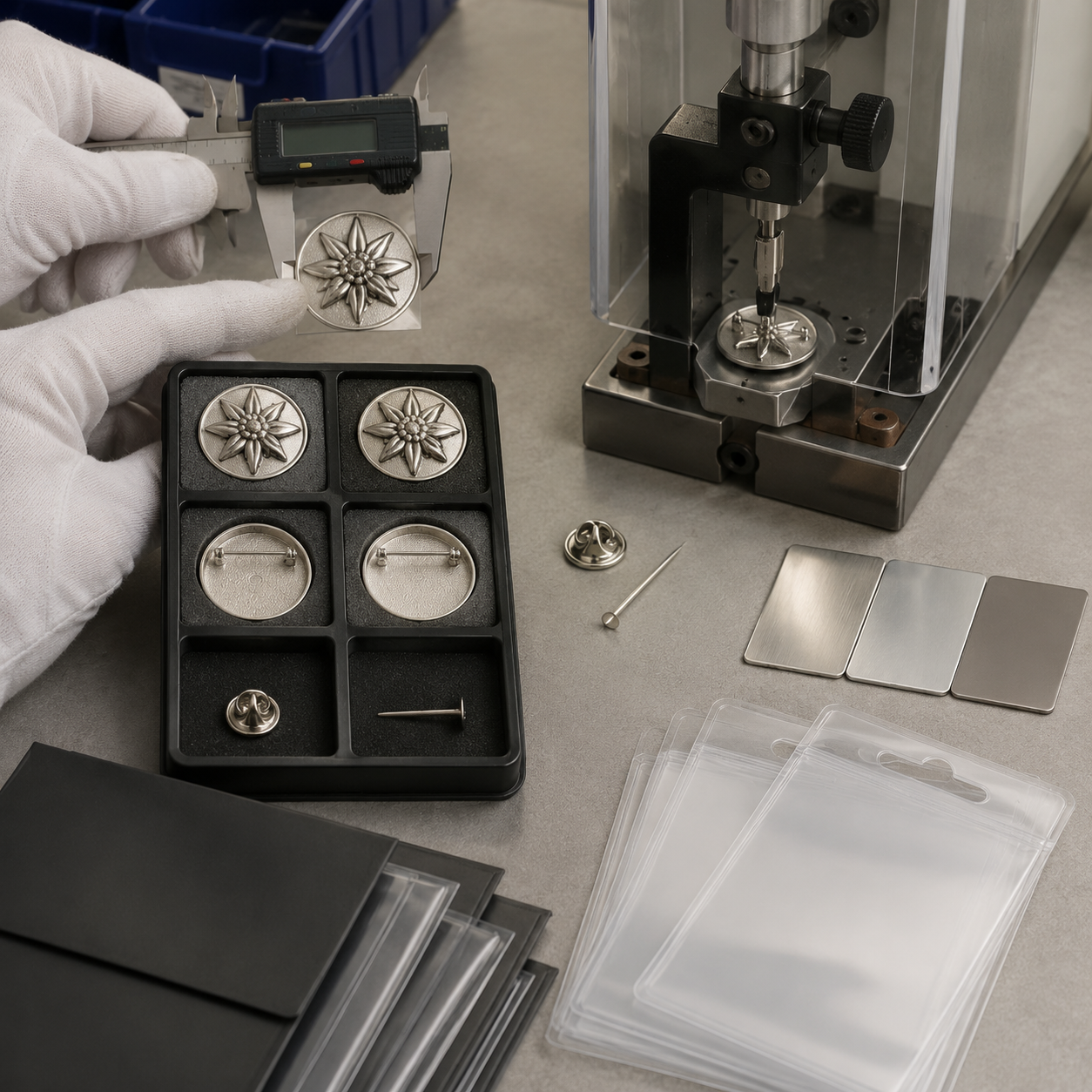
| Face geometry | Width, height, thickness, edge profile, datums, units, tolerances, and measurement locations | Dimensioned drawing and production-sample measurements |
| Rear construction | Post material and grade, coordinates, orientation, joining process, clutch type, and exposed-edge condition | Rear-view drawing, component records, and approved sample |
| Component BOM | Base metal, each plating layer, coatings, inks, enamel, solder, adhesive, stones, pin, clutch, battery, electronics, and packaging | Signed component-level BOM with material and supplier traceability |
| Finish | Layer sequence, layer material, measurable target where used, appearance reference, test location, and verification method | Approved finish reference plus applicable inspection, test, or process records |
| Closure performance | Loading direction, conditioning, fixture, force unit, dwell time, failure definition, and acceptance criterion | Raw results tied to the production lot and approved method |
| Claims | Each proposed metal, plating, gemstone, material, durability, and electronic-function statement | Claim-specific substantiation matching the finished SKU |
| Labels and packaging | Origin marking, applicable warnings, identifiers, retail presentation, and unit count | Approved production artwork and representative-unit photographs |
| Variants and changes | Shared components, variable materials, colorants, sub-suppliers, electronics, tools, and change triggers | Variant matrix and written approval before controlled changes |
Illustrative RFQ assumptions to verify in the supplier quote: These values are example procurement inputs for one proposed brooch SKU. They are not legal thresholds, market norms, or supplier capability claims.
- Finished face width of 30.0 millimeters with a buyer-assumed tolerance of plus or minus 0.3 millimeter.
- Nominal face thickness of 1.5 millimeters with a buyer-assumed tolerance of plus or minus 0.1 millimeter, excluding rear hardware.
- Post-center position no more than 0.5 millimeter from the drawing datum under the buyer's example assumption.
- Illustrative closure check using a minimum axial load of 20 newtons held for 10 seconds, with the fixture, conditioning, failure definition, and product suitability still requiring buyer engineering approval.
- Die-struck brass face with the exact alloy pending supplier declaration, stainless-steel pin post with the exact grade pending approval, and a neutral silver-color electroplated finish with the layer stack and thickness pending quotation.
Replace or verify every example value in the supplier quote and final purchase specification. Acceptance criteria should reflect the approved design, intended use, safety review, and manufacturing process.
Brooch Compliance Evidence and Labeling Release
Require the supplier to return an applicability matrix with these fields:
requirement or buyer control | cited source or contractual basis | applies or does not apply | rationale | affected SKU and components | evidence identifier and date | label or marking | responsible party | quoted cost | delivery milestone | change trigger | release status
The release file should include:
- Signed brooch specification, controlled drawings, component BOM, claim register, and variant matrix.
- Applicability matrix separating federal, state, channel, and buyer-selected controls.
- Complete laboratory reports identifying the tested SKU revision, component or finished-product scope, sample photographs, methods, results, report date, and laboratory.
- Any required certificate issued by the legally responsible manufacturer or importer rather than a laboratory report relabeled as a certificate.
- Approved retail-unit and carton artwork showing each applicable origin marking, warning, identifier, or tracking element identified by the applicability review.
- Approved master sample and records linking compliance samples to production materials and the released revision.
- Pre-shipment inspection results, deviations, corrective actions, and written change approvals.
For required children's-product testing, verify that the laboratory was CPSC-accepted for the applicable rule and scope when testing occurred. Laboratory accreditation or a quality-system certificate does not by itself certify the brooch. Do not describe a SKU as certified unless a current document covers the exact construction and claimed scope.
| Label or marking area | Evidence required before artwork approval |
|---|---|
| Country of origin | Part 134 applicability rationale, actual manufacturing origin, proposed wording, marking method, location, and retail presentation |
| Children's-product information | Applicable rule matrix, approved tracking or warning content where required, and certificate plan |
| Battery product | CPSC applicability review, final cell and enclosure identity, warning artwork, and packaging evidence |
| Radio device | FCC applicability or authorization file, final hardware configuration, required identifier or label, and user-information proof |
| Jewelry or material claim | Claim register and substantiation for the final BOM, finish stack, stones, and artwork wording |
The pre-shipment inspection specification should identify the production lot, sample-selection method, defect classes, acceptance and rejection rules, measurement tools, functional test setup, and failed-unit disposition. Brooch-specific checks should cover face dimensions, post position, clutch engagement, buyer-defined closure retention, finish consistency, exposed burrs or edges, artwork orientation, retail packaging, origin marking, unit count, and carton traceability.
If the buyer selects a sampling standard, state its title, edition, lot definition, inspection level, and acceptance settings. Identify it as a buyer or channel control unless a cited requirement makes it mandatory. Sampling acceptance does not override a failed regulatory test or a missing required certificate.
Landed Cost and Delivery Controls for United States Brooch Orders
Compare quotations only when suppliers price the same construction, evidence scope, packaging, and delivery responsibilities. Request separate lines for tooling, development samples, compliance samples, unit pricing at each requested quantity, testing, report issuance, certificate preparation where applicable, packaging, inspection, freight, duty assumptions, brokerage, correction, and retesting.
Use buyer evaluation formulas such as:
evaluated landed cost = goods + tooling allocation + compliance allocation + packaging + inspection + freight + duty + brokerage + expected nonconformance allowance
compliance allocation per released unit = fixed applicable test and document cost / released order quantity
These are evaluation methods, not market-price claims. Record the source, currency, quote date, validity period, SKU scope, quantity basis, delivery term, and exclusions for every input.
Example calculation and assumptions to verify in the supplier and laboratory quotes: Assume a fixed testing and document allowance of USD 1,200 for one defined brooch SKU revision and a released order quantity of 10,000 units. The illustrative allocation is USD 0.12 per released unit, calculated as USD 1,200 divided by 10,000 units. These values are not quoted prices or market benchmarks. Replace them with dated proposals for the actual test matrix, variants, retests, reports, and certificate responsibilities.
Have a customs broker classify the finished brooch from its actual material, construction, and function and confirm the duty treatment effective on the expected entry date. Do not copy a classification or rate from a visually similar product. The commercial schedule should identify the delivery term, named place, importer of record, customs-document owner, and compliance-record owner.
Require dated milestones for specification and artwork freeze, construction sample, compliance sample, testing, corrective action, production release, pre-shipment inspection, document approval, cargo booking, and expected arrival. Each milestone should identify its start event, responsible party, dependency, and effect on the arrival commitment. Include a contractual hold between evidence approval and mass-production release, plus supplier-quoted time for correction and retesting.
Brooch Compliance RFQ Checklist
- [ ] State that the sole primary sales market is the United States and list the intended states, retailers, marketplaces, and channels.
- [ ] Declare the proposed general-use or child-directed classification and require a source-linked rationale.
- [ ] Attach intended-user descriptions, packaging concepts, and artwork that could affect classification or claims.
- [ ] Provide controlled front, rear, and side drawings with units, datums, dimensions, tolerances, post position, and closure orientation.
- [ ] Require a component BOM covering metals, plating layers, coatings, inks, enamel, solder, adhesive, stones, pin, clutch, battery, electronics, and packaging.
- [ ] List every jewelry, material, durability, and electronic-function claim with the required substantiation.
- [ ] Require an applicability matrix separating federal and state requirements from retailer and buyer controls.
- [ ] Identify which variants may share evidence and request the technical basis for the proposed grouping.
- [ ] Request the laboratory, applicable scope, methods, sample source, report format, and responsible certificate issuer.
- [ ] For a child-directed brooch, request CPSC-accepted laboratory scope evidence and the responsible party's certificate plan.
- [ ] For a battery or radio product, identify the final hardware, enclosure, warnings, packaging, authorization path, and transport-document responsibilities.
- [ ] Submit retail-unit and carton artwork showing the proposed origin marking and each applicable warning or identifier.
- [ ] Prohibit production release before written approval of the specification, master sample, artwork, and required evidence.
- [ ] Define production inspection checks, failed-unit disposition, corrective-action duties, and retesting responsibilities.
- [ ] Require written approval before changes to materials, sub-suppliers, plating, coatings, adhesive, battery, module, antenna, firmware, tooling, or assembly.
- [ ] Request line-item pricing for tooling, samples, tests, reports, packaging, inspection, freight, duty assumptions, brokerage, correction, and retesting.
- [ ] Require dated delivery milestones, dependencies, hold points, and the schedule effect of failed testing or rejected inspection.
Methodology and Limitations
This article uses a classification-first method: define the intended user and exact brooch architecture, map the components and claims to cited regulatory contexts, identify the evidence and responsible party, and convert the result into measurable RFQ, cost, schedule, and release controls. The children's-product age and lead values were transcribed from the linked CPSC guidance at the March 2025 source-review cutoff; they were not inferred from commercial sourcing pages.
Official source contexts include CPSC guidance for children's products and battery products, the FTC and eCFR for jewelry representations, eCFR for imported-article marking, FCC guidance for radio devices, PHMSA guidance for lithium-battery transport, and California DTSC and OEHHA materials for separate state reviews.
The electronic-badge article is used only to identify product-architecture questions. The supplied cross-category kitchenware sourcing article was reviewed only as secondary procurement-process context. It does not support any brooch material, legal threshold, price, order quantity, lead time, or supplier-capability claim in this article.
Final applicability cannot be determined without the actual brooch, component BOM, finish stack, packaging, claims, intended users, destination states, and channels. Laws, regulations, agency guidance, laboratory scopes, retailer protocols, tariff treatment, and product construction may change after the March 2025 review cutoff. Before purchase-order release, verify current obligations with qualified counsel or a compliance laboratory, tariff treatment with a customs broker, and channel requirements with the relevant retailer or marketplace. Confirm that every report, certificate, authorization, and label covers the production revision, and replace or verify all illustrative dimensions, test conditions, and cost calculations in the supplier quote and final purchase specification.
Discuss Your Requirements
Review our manufacturing capabilities, then share your specifications for a supplier-fit review.